Saturation Diving for Marine Science

In 2018, eight years after the disastrous explosion of the BP Deepwater Horizon Oil Drilling Rig, I was invited to speak at the Gordon Research Conference (GRC). The conference topic was “The Functional Roles of Mesophotic Coral Reefs in the Anthropocene Mesophotic Coral Reef Ecosystems.” It was held at Bates College in Lewiston, Maine.

The term mesophotic refers to the “middle light” region of the ocean, generally assumed to begin at about 30 meters seawater (98 feet sea water, fsw) and reaching to 150 meters (490 fsw.) [Exact values vary depending on location; in clearer ocean water where deeper water corals grow, light penetrates deeper (up to 200 meters) than in sediment-filled water.]  Beyond the mesophotic zone, the available light is too low to support photosynthesis.

Mesophotic Zone image generated by OpenAI’s DALL-E 3 and modified by the author.

As the Scientific Director of the Navy Experimental Diving Unit, I spoke on the topic of “Saturation Diving as a Tool for Mesophotic Depths and Beyond.” Ten years before that, I’d spoken at an American Academy of Underwater Sciences (AAUS) Conference on “What the Navy Can Contribute to Scientific Diving.” So, the GRC talk was a continuation of the theme.

Well, my GRC talk was met with polite skepticism. To be fair, some marine biologists, such as Dr. Sonia J. Rowley, want to be hands-on with their research subjects. Having trained to be a science diver, I fully understand that. But in my opinion at the time, sometimes you just need a professional, well-equipped diver to do the dangerous dives for you.

CCR Bounce Dives

For a fictional example, an independent minded researcher plans on using a closed-circuit rebreather (CCR) to make a single dive to 160 meters. The purpose of the dive is to transplant deep water corals for 15 minutes working on the bottom. The breathing gas planned for the work on the bottom is 5% oxygen, 83% helium, and 12% nitrogen, maintaining a PO2 of 1.1 atmospheres at depth, 1.3 PO2 during decompression.

The time cost for those 23 minutes of bottom time (15 min of working time) is 9.3 hours, mostly spent decompressing[1] during the ascent back to the surface. (If you’re lucky enough to decompress on a wall coming up, then you’ve found the perfect dive spot!)

The next day, the same dive is repeated, implanting coral in another site a few yards away from the first. After two days of diving, 30 minutes of work on the bottom will have been completed, and about 18 hours will have been spent unproductively, hanging on a line, decompressing, exposed to the elements, at constant risk of life support (CCR) failure and the need for bailout, and deterrence of curious marine predators.

Saturation Diving

The alternative to decompression-intense “bounce” dives, is saturation diving from a habitat under pressure, a home away from home. Why spend nine hours hanging on a line when those same hours could be spent working at depth?

Of course, a saturation diver still must decompress, but they only do it once, at the end of the work-filled mission which can last days or weeks.

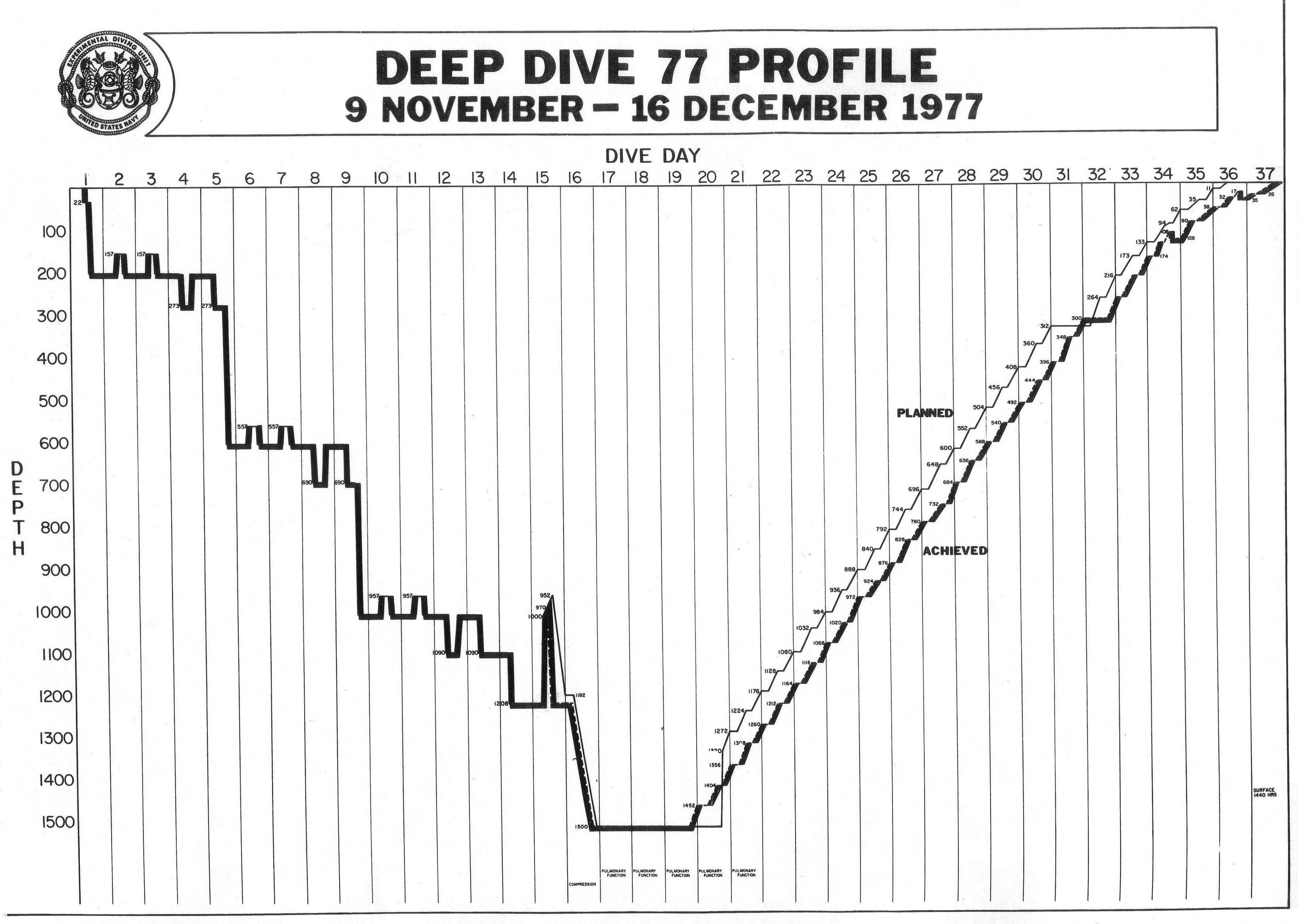
The 37 day diving profile for a saturation dive to the pressure equivalent to 1500 fsw. Author’s copy.

Living Under Pressure on the Surface

One method which works well for the U.S. Navy and oil-well workers around the world, is to descend to the ocean bottom under pressure in a diving bell, and once bell pressure and sea water pressures equalizes, swim or walk to the worksite. At the end of the shift, divers return to the surface ship or platform, still under bottom pressures, and lock in to the pressurized living chambers.

NEDU’s Saturation Detachment hyperbaric living chambers connected to the diving bell. Photo courtesy of NOAA.
Saturation diving bell being lowered through the diving well of a support vessel, into the deep water of the Gulf. Photo courtesy of NOAA.
NEDU’s saturation diving bell at 722 fsw at 1:24 in the afternoon. Photo courtesy of NEDU.
US Navy Saturation Divers planting coral at 100 meters depth in the Gulf of Mexico. Photo courtesy of C-Innovation.

This US Navy assisted coral reef restoration dive series was described in a 2024 NOAA publication.

NOAA used US Navy Sat Divers on one coral propagation mission, and rebreather divers on another mission.

Upon a repeat visit of a NOAA vessel to the area where Navy Sat Divers implanted deep corals, there was a 95% survival rate of a diverse genetic population of corals.

Living Under Pressure on the Sea Floor

There has been a rich history of aquanaut habitats placed on the sea floor. As a graduate student at Florida State University, I spent the summer in Panama City, Florida diving with retired Navy divers and fellow graduate students in the Navy, NOAA, and State University System Institute of Oceanography funded Scientist in the Sea (SITS) Program.

One diving exercise was to resurface the SEALAB I habitat sitting in 60 feet of seawater. We were very hands on with the habitat, which now sits at the Museum of Man in the Sea, in Panama City Beach.

Sealab 1(1964, 194 fsw, 59 meters)

Sealab 1. At the Man in the Sea Museum, Panama City Beach, FL.

Sealab I was originally deployed in Bermuda in 1964 at 194 fsw (59 msw).

Helgoland (1969, 25 meters)

Helgoland. By Klugschnacker – Own work, CC BY-SA 3.0

The next habitat I encountered was Helgoland, an uber-sized German habitat, decommissioned at the end of the 1970s. It was displayed outside GKSS Research Centre, Geesthacht, Germany where another Navy scientist and I were conducting physiological studies on a trimix dive to 450 meters sea water. Peter Bennett from Duke University was proving once again how Trimix, (oxygen, helium, and nitrogen), could suppress the High Pressure Nervous Syndrome.

Aquarius Reef Base

Aquarius Reefbase.

At one time during my career at the Navy Experimental Diving Unit, I was a part of the certification board for the Aquarius habitat. I got to dive on it and in it, in an inspection capacity. But regrettably, I never got to saturate in it.

Other habitats

The Sealab projects did not end with Sealab I. The Navy followed up with larger and more ambitious habitats, known as Sealab II (1965, 205 ft, ~62 meters), and Sealab III (1969, 610 feet, ~185 meters). Then there was La Chulupa (1972, 20 meters, 66 feet), Tektite (1969, 49 feet) and Hydrolab (1970, 50 feet.)

La Chulupa.

Even today the La Chulupa habitat, renamed Jules Undersea Lodge, rests in thirty feet of seawater in a shallow lagoon. Touted as an underwater hotel, it accepts visits or stays by scuba divers. (As an instructor in SITS 2000, I visited, but did not stay.)

 Jules Undersea Lodge.

A 60-year Time Jump

From the U.S. Navy’s Sealab series of saturation dives to today is an approximately sixty-year leap into the future. In that time span, engineering and manufacturing improvements have advanced two generations. Human’s saturation experience at depth has advanced from 65 feet to over 2000 feet. As a result, the new generation of Deep’s undersea habitats promises to be a marvel to behold.

Concept visualization of Deep’s expandable Sentinel habitats.

Advances in Breathing Apparatus

There’s not much point in living underwater if you can’t step outdoors. Underwater breathing apparatus have likewise made great advances over the last 60 years. The greatest advance is in electronically controlled closed circuit rebreathers; known categorically as e-CCR.

Diver Burden

I don’t know of any diver who enjoys being burdened with a sometimes-bulky rebreather, plus large cylinders for bailout gas, and offboard cylinders for decompression gas mixes. But their survival depends on it. All that gear is required to safely accomplish a few minutes of useful work at depth.

CCR Bounce diver Dr. Sonia J. Rowley: multiple gas bottles on person for gas switches on way to the bottom and back, plus open-circuit bailout gas for 10 hours in case of rig failure or floodout. A depth of 200 msw (650 fsw) or more, is achievable with modern e-CCRs, although not recommended.
Sonia J. Rowley at depth. Photo by Dr. Dan Barshis in Indonesia, Wakatobi, 2023.

One solution is to dive with two or more rebreathers, one being a backup. That may be an improvement, but has not guaranteed safety in all situations.

The Case for Underwater Habitats

As Aquanauts have opined through the years, there is nothing more enjoyable than waking up, fixing a hot breakfast, putting on your minimal dive gear, and jumping into the water to work as long or as little as you wish. No hanging on a line in cold water to decompress, no wave action, just becoming as close to an ocean inhabitant as is possible for humans.

As the Deep company states, humans can become aquatic, once again.

There are no persons better equipped to describe the newest undersea habitat concept than those interviewed here by PADI.

The January 2026 PADI interview with Deep’s Dr. Dawn Kernagis, Norman Smith, and Roger Garcia.

The future of deep-ocean science may depend less on how deep we can dive than on how long we can remain. When expertise is embedded at depth—unhurried, observant, and continuous—the ocean stops being a hostile place briefly visited and becomes a working environment shaped around human capability. In that sense, saturation aquanauts are not relics of an experimental past, but early examples of a new kind of professional: knowledge workers operating under pressure, where sustained presence, not momentary endurance, defines both safety and success.


[1] Decompression model: Buhlmann ZH-L16C; Conservatism: Gradient factors (50/75)

Remote Viewing – Stretching the Limits of Science in Fiction

puthoff_lg
Laser physicist Harold E. Puthoff.

I once met the Father of the U.S Remote Viewing program, unawares.

A decade ago, at the request of a Navy engineer who ended up being a character in my novel Middle Waters, I invited Dr. Harold E. Puthoff into the Navy Experimental Diving Unit to give a talk on advanced physics. He had attracted a small but highly educated and attentive crowd which, like me, had no idea that the speaker had once led the CIA in the development of its top secret Remote Viewing program.

Of late, Puthoff’s energies have been directed towards the theoretical “engineering of space time” to provide space propulsion, a warp drive if you will. Although strange by conventional physics standards, similar avant-garde notions are receiving traction in innovative space propulsion engines such as NASA’s EMdrive.

Puthoff is the Director of the Institute of Advanced Studies at Austin, in Texas, but before that, and more germane to this discussion, Puthoff was a laser physicist at the Stanford Research Institute. It was there that the CIA chose him to lead a newly created Remote Viewing program, designed to enable the U.S. to maintain some degree of competiveness with Russia’s cold war psychic spying program.

09-02-1220_26_07low
6800 feet down in the Desoto Canyon

Psychic spying was purportedly the method used by the two superpowers to visualize things from a distance; not from a satellite, but from what some call the highly developed powers of the mind’s eye. If we believe what we read on the subject, Remote Viewing was eventually dropped from the US psychic arsenal not because it had no successes, but because it was not as reliable as signal intelligence (SIGINT), satellite imagery, and spies on the ground. But, it has been argued, it might be ideal in locations where you can’t put spies on the ground, such as the dark side of the moon, or the deep sea .

Serendipitously, as I started writing this blog post, Newsweek published a review of the Remote Viewing efforts of Puthoff and others in a November 2015 issue. The article seemed fairly inclusive, at least more so than other articles on Remote Viewing I’ve seen, but the Newsweek author was not particularly charitable towards Puthoff. Strangely, the strength and veracity of Puthoff’s science was reportedly criticized by two New Zealand psychologists who, as the Newsweek author quoted, had a “premonition” about Puthoff.

“Psychologists” and “premonitions” are not words commonly heard in the assessment of science conducted by laser physicists, especially those employed by the CIA. The CIA is not stupid, and neither are laser physicists from Stanford.

To the extent that I am able to judge a man by meeting him in person and hearing him talk about physics, I would have to agree with Puthoff’s decision to ignore his ill-trained detractors. Every scientist I know has had detractors, and as often as not those detractors have lesser credentials. Nevertheless, I have the good sense to not debate the efficacy of remote viewing. I don’t know enough about it to hold an informed opinion. However, there seems to be some evidence that it worked occasionally, and for a science fiction writer that is all that is needed.

Enrico%20Fermi%20chalkboard
Nuclear physicist Enrico Fermi.

As my curiosity became piqued by the discovery of the true identity of my guest speaker at NEDU, and as I learned what he had done for the U.S. during the Cold War, I thought of another great physicist, Enrico Fermi, one of the fathers of the atomic bomb. In the midst of a luncheon conversation with Edward Teller, Fermi once famously asked, “Where are they?” The “they” he was referring to, were extraterrestrial aliens.

What became known as Fermi’s Paradox went something like this: with all the billions of stars with planets in our galactic neighborhood, statistically there should be alien civilizations everywhere. But we don’t see them. Why not? “Where are they?”

In most scientists’ opinions, it would be absurdly arrogant for us to believe we are the only intelligent life form in the entire universe. And so ETs must be out there, somewhere. And if there, perhaps here, on our planet, at least occasionally. And that is all the premise you need for a realistic, contemporary science fiction thriller.

But then there is that pesky Fermi Paradox. Why don’t we see them?

Well, they could indeed be here, checking us out by remote viewing, all the while remaining safely hidden from sight. After all, as one highly intelligent Frog once said, humans are a “dangerous species” fictionally speaking of course.

That “hidden alien” scenario may be improbable, but it’s plausible, if you first suspend a little disbelief. If we can gather intelligence while hiding, then certainly they can, assuming they are more advanced than humans. A technological and mental advantage seems likely if they are space travelers, which they almost have to be within the science fiction genre. Arguably, fictional ETs may have long ago engineered space-time, which could prove mighty convenient for tooling around the galactic neighborhood.

So, if in the development of a fictional story we assume that ETs can remote view, the next question would be, why? Is mankind really that dangerous?

Well, I don’t intend for this post to be a spoiler for Middle Waters, but I will say that the reasons revealed in the novel for why ETs might want to remote view, are not based on fear of humans, but are based on sound science. From that science, combined with a chance meeting with Hal Puthoff, the basic premise of a science fiction thriller was born.

So, to correct what some of my readers have thought, I did not invent the concept of “remote viewing”. It is not fictional; it is real, and was invented and used by far smarter people than myself, or even that clever protagonist, Jason Parker.


Why Deep Saturation Diving Is Like Going to the Moon, and Beyond

This week, as the Space Shuttle is making its last circuits around our planet, I lament what has happened to our space program. Yet, I am reminded of another exploration program that has, like the shuttle and the moon programs, reached incredible milestones only to retreat to a less exotic but still impressive status. That other program is experimental, deep saturation diving.

I have been privileged to conduct human physiological research on several deep saturation dives, one being a record-breaking U.S. Navy dive at the Navy Experimental Diving Unit (NEDU) in 1977 to a pressure equivalent to that found at 1500 feet sea water (fsw), or 460 msw*, and on a 450 msw (1470 fsw) dive at the GUSI diving facility at the GKSS Institute in Geesthacht, Germany in 1990. For perspective, the safe SCUBA diving depth is considered to be 130 fsw, although technical and cave divers often descend deeper, to 300 fsw or so.

NEDU, Panama City, FL

Dives in hyperbaric chambers like at GUSI and NEDU are simulated; the divers don’t actually go anywhere. But the effects of the high pressure on the divers’ bodies are just as they would be in the ocean. Of course, even in simulated dives, divers wear Underwater Breathing Apparatus, and descend into water contained within the hyperbaric complex.

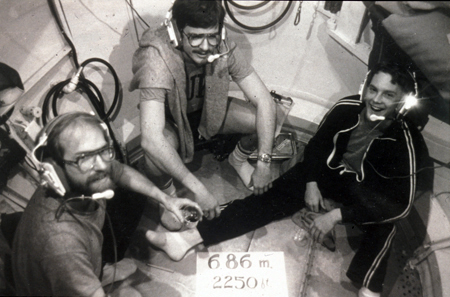
In 1979, NEDU again set the U.S. Navy record for deep diving to 1800 fsw (551 msw). At Duke University in 1981, the U.S. record for pressure exposure was set by three saturation divers inside an eight-foot diameter sphere. The internal pressure was 2250 fsw (686 msw). One of those divers went on to become the senior medical officer at NEDU, none the worse for his high pressure exposure.

The French company Comex, of Marseille used an experimental gas mixture of hydrogen-helium-oxygen to reach 675 msw, before being forced back to 650 msw due to physical and physiological problems with the divers. However, like teams attempting the summit of Mount Everest, one diver from the dive team was pressed to a world record of 701 msw (2290 fsw), just squeaking past the U.S. record.

There is a poorly understood physiological barrier called the High Pressure Nervous Syndrome (HPNS) that limits our penetration to ever deeper depths. In spite of the use of increasingly exotic gas mixtures, helium-oxygen in the U.S. Navy, helium-nitrogen-oxygen at Duke University, and hydrogen-helium-oxygen at Comex, all attempts to dive deeper have, to date, been rebuffed.

Just as I had thought as a young man that trips to the moon would be common-place by now, I had also assumed diving to 3000 feet would be routine. But it is not.

In my early research days I was interested in the effects on organisms of very high pressure, 5000 psi, which is equivalent to a depth of over 11,000 feet (3430 meters). We now know those effects can be profound, altering the very structure of cell membranes. Reversing those effects while maintaining high pressure, at great depth, is a daunting scientific task. We don’t yet know how to do it.

What we do know is that reaching 1500 feet can be done without too much difficulty. In the 1980s it became almost routine to dive to 1000 feet at both the Naval Medical Research Institute (Bethesda) and NEDU. Deep saturation diving is a thriving business in the oil fields of the Gulf of Mexico and the North Sea.

Click for a larger image.

But as for the similarity between deep saturation diving and NASA’s moon missions, in the Apollo program it took slightly over three days to get to the moon, and almost an equal time to return. But as the above dive profile shows, it took sixteen days to reach the maximum depth of 1500 fsw, and seventeen days to safely return. Over that period of time astronauts would have whizzed past the moon and been well on their way to Mars. Unlike spacecraft and astronauts, divers must slow their descent to avoid HPNS, and must slow their return to the surface to avoid debilitating and painful decompression sickness. Diving without submarines or armored suits is very much a demanding, physical stress.

Politically, exceeding our current depth limits of approximately 2000 feet is akin to returning to the moon, and going beyond. We could do it, but at what cost? Should we? Will it ever be a national priority?

Maybe not for the United States, but I have a suspicion that other countries, perhaps not as heavily committed to space as we, will find the allure of beating current diving records irresistible. If there are medical or pharmacological interventions developed for getting divers safely and productively down to 3000 feet, then that would be a scientific achievement comparable to sending men to Mars.

*[The feet to meters conversion is slightly different from the feet of sea water to meters of sea water conversion. The latter represents pressure, not depth, and therefore includes a correction factor for the density of sea water.]

Verified by ExactMetrics